



A specimen that leaves the draw site at 4°C and arrives at 11°C is usually a rejected specimen, which means a second draw and a patient who has to come back in.
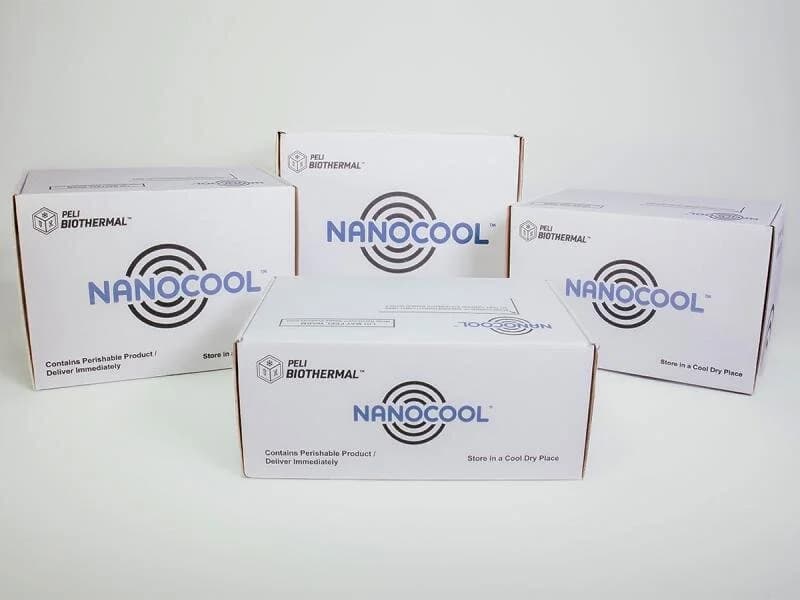
For refrigerated and frozen specimen shipping, the choice usually comes down to three methods: dry ice, gel packs, and evaporative cooling systems such as NanoCool™ from Peli BioThermal. People compare them as if they were interchangeable. They aren't, and matching the wrong one to a shipping lane is one of the more avoidable ways to lose a sample.
Our cold chain shipping guide covers temperature bands and the standards behind them. This post does one job: it compares the three refrigerant methods on temperature range, preparation, time in transit, shelf life, sizing, cost, regulation, reuse, recycling, and failure risk, and ends with a side-by-side comparison table.
Which is better: dry ice, gel packs, or NanoCool?
If the specimen has to stay frozen, use dry ice. Nothing else here gets to −70°C.
If you ship high refrigerated volume from a handful of well-equipped sites, with freezer space, trained packers, and a reliable way to get packs back, gel packs are hard to beat on cost.
And if the specimen needs 2–8°C but whoever's packing it has no freezer and no cold-chain training (a physician's office, a mobile phlebotomist, a collection depot, a patient's kitchen), that's the gap NanoCool was built to fill.
How do dry ice, gel packs, and NanoCool work?
Dry ice
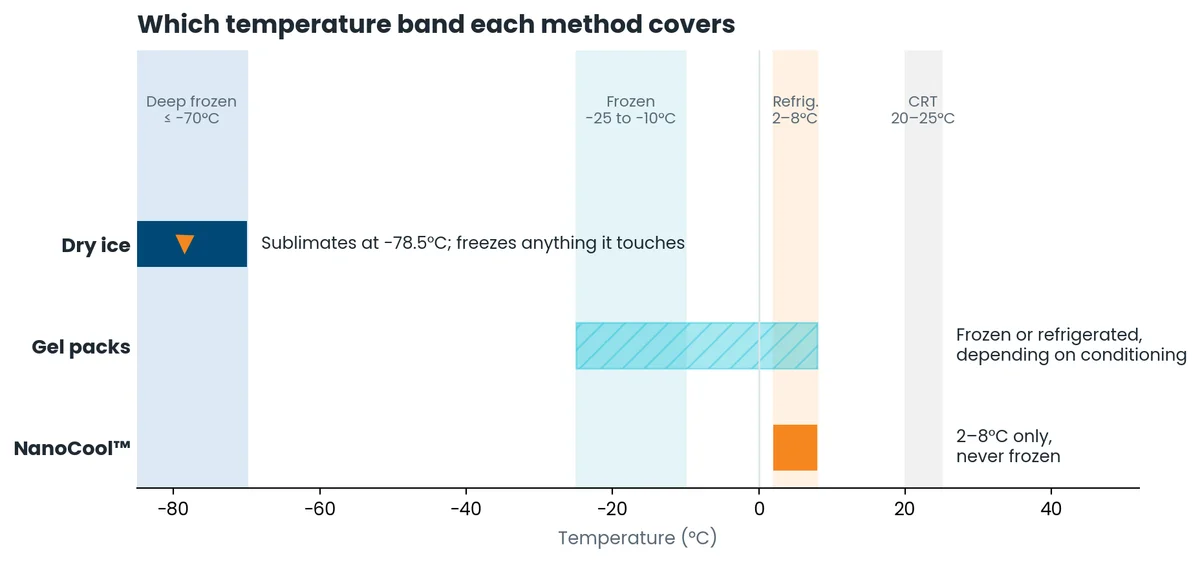
Dry ice is solid carbon dioxide. It skips the liquid stage entirely and turns straight to gas at about −78.5°C (−109.3°F). That extreme cold is why it's the default for frozen and ultra-frozen material, and also why it has no place near a refrigerated specimen: it'll freeze it.
It starts disappearing the moment it's made. Dry Ice Corp puts the loss at roughly 5 to 10 pounds every 24 hours in a well-insulated cooler, so you can't keep a stock on a shelf. You buy it close to shipping and size it to the journey.
Gel packs
Gel packs are sealed pouches of water-based gel or phase change material that absorb heat as they warm. They're cheap, and nobody needs dangerous goods training to ship them.
The catch is preparation. Every pack needs conditioning before every shipment; Labcorp's client instructions call for four hours or more in the freezer, frozen solid. And a pack that goes straight from the freezer into the box can freeze the specimen it's meant to protect, which is why Labcorp tells clients to keep frozen packs out of direct contact with specimens.
NanoCool™
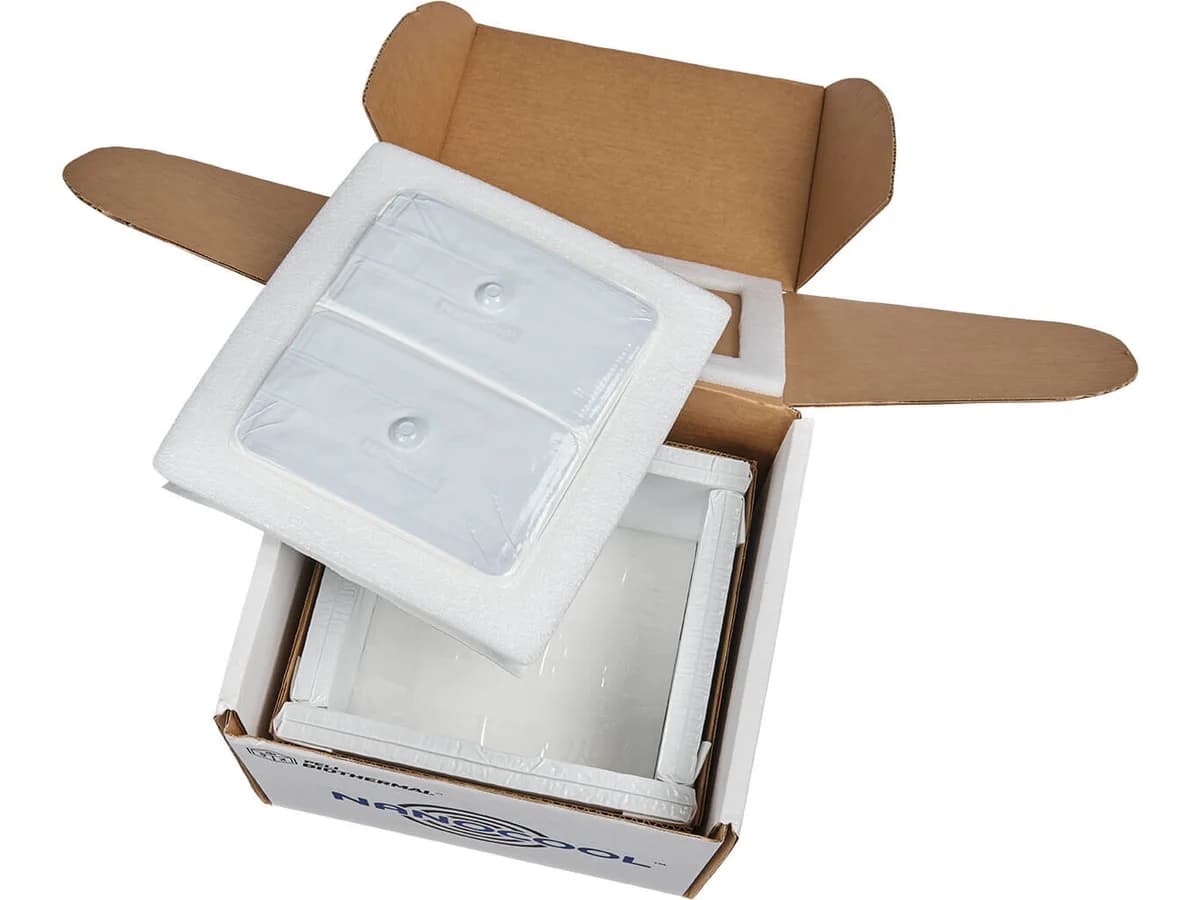
NanoCool works on a different principle. Each shipper contains a vacuum-sealed cooling engine; pressing the activation button starts water evaporating inside it, which pulls heat out of the payload compartment. About 20 seconds later the NanoCool logo turns blue, confirming that it's working. There's nothing to freeze or assemble beforehand, and units sit at room temperature (17–25°C) until someone needs one.
Peli BioThermal makes three versions:
- Cooling Systems use evaporative cooling alone, qualified for 48 to 92 hours.
- Universal Systems add a phase change material layer for lanes with temperature spikes, qualified for 48 to 96 hours.
- Shuttle is the compact option, built to fit UN3373-designated envelopes for overnight specimen runs of up to 40 hours (per Peli's NanoCool sell sheet).
How they compare
Temperature range
Start here, because it rules options out before price even comes up.
Dry ice holds frozen and deep-frozen material, −20°C and well below, and it should never go near a sample that mustn't freeze. Gel packs can cover refrigerated or frozen profiles depending on the pack and how it's conditioned. NanoCool is 2–8°C only; it isn't a frozen solution, and it should never share a box with dry ice.
Preparation and pack-out
Day to day, preparation is what separates them most.
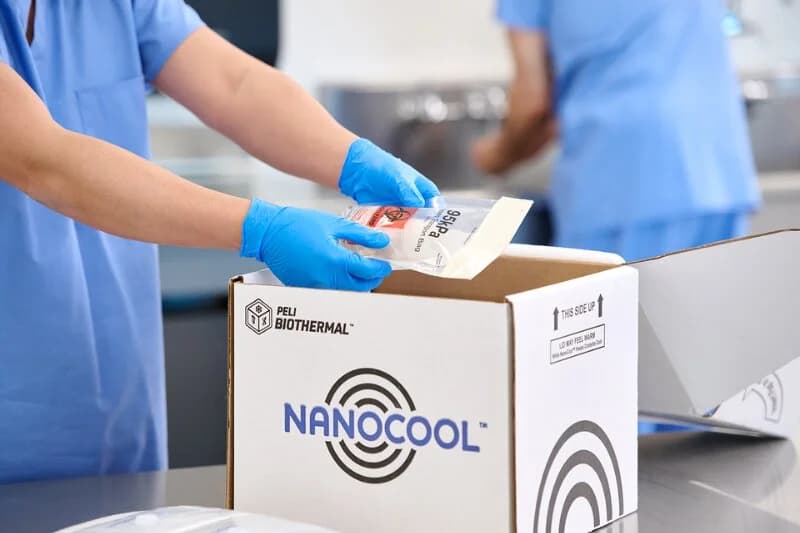
Dry ice needs a same-day supply, an insulated storage chest, protective gloves, and packaging that lets carbon dioxide escape. Gel packs need freezer or refrigerator space and hours of conditioning before each use, then careful placement so the specimen neither warms up nor freezes. With NanoCool, the packer presses a button, checks that the logo has turned blue, puts the specimen in, and closes the lid.
A central lab with walk-in freezers and a trained shipping team handles gel packs well. A two-physician practice packing its last specimen of the day usually can't.
Time in transit
Dry ice lasts as long as there's dry ice left, so duration depends on how much you pack, and every extra hour of coverage adds weight and cost. In most specimen programs, gel pack shippers are built around overnight delivery; stretching them further means more packs, a thicker cooler, or both.
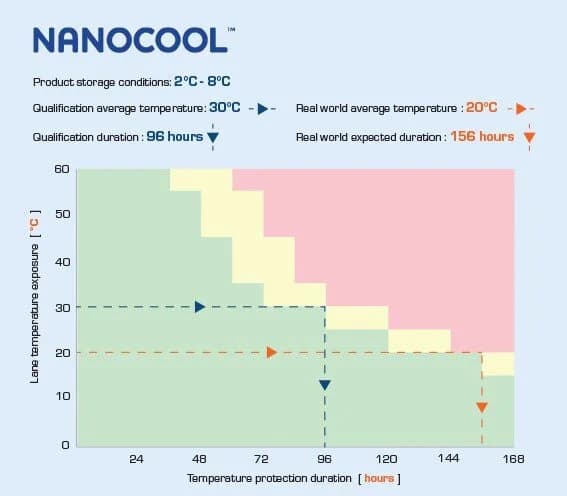
NanoCool's qualified durations run from 40 hours for Shuttle to 96 hours for Universal. Peli BioThermal's published thermal data shows the Universal system holding 2–8°C for up to 156 hours at 20°C ambient.
Shelf life and storage
Dry ice can't be stockpiled, since it sublimates in the storage chest just as it does in the shipper. Gel packs keep for a long time but aren't usable until they've been conditioned. NanoCool is the only one of the three you can take off a room-temperature shelf and use immediately. Storing it above 25°C shortens its life, though, and putting it in a freezer can make it fail.
Sizes and payload
Dry ice and gel packs scale to almost any payload. NanoCool doesn't. It comes in fixed configurations with payload volumes between roughly 1 and 8.25 liters, which covers most specimen and small-parcel work but not bulk freight.
Cost
Per unit, gel packs are the cheapest. Dry ice lands in the middle once you count buying it again for every shipment, and NanoCool costs the most per box.
That ranking can flip once you count everything each method needs around it:
- freezer, refrigerator, or dry ice storage at every packing site
- staff time to condition, pack, and check each shipment
- dimensional weight, since heavy EPS coolers and refrigerant push freight charges up
- dangerous goods handling and carrier surcharges for dry ice
- recovering reusable packs, assuming they come back
- the cost of a single excursion: a rejected sample, a second collection, and a result that arrives days late
For high-volume shipping from a central site, gel packs usually win on total cost. Spread the same volume across dozens of low-volume sites with no cold storage, though, and the math often shifts toward a method that needs no preparation at all.
Regulation and safety
Dry ice is the only regulated dangerous good of the three. Shipped by air, it's UN1845, Class 9. Under 49 CFR 173.217, the packaging has to let carbon dioxide vent so pressure can't build up. Air packages need the dry ice label and the net weight marked on the outside, and the shipper has to make arrangements with the carrier for each shipment. Packages holding 2.5 kg (5.5 lb) or less qualify for some exceptions but still need marking. Dry ice is also a burn hazard and, in an enclosed space, an asphyxiation risk.
Gel packs and NanoCool are both non-hazardous for transport. NanoCool is designed for use with packaging built to UN3373 Category B requirements.
Reuse
Gel packs are the only reusable option here. In a closed loop, where the same clients ship to the same lab every week and the packs come home, that's a real advantage. In one-way shipping it largely disappears, because the packs don't come back.
Dry ice is gone by the time anyone opens the box. NanoCool is single use by design.
Recycling and sustainability
No method here is waste-free.
Dry ice leaves no refrigerant behind, but it releases carbon dioxide and usually travels in an EPS foam cooler. Gel packs usually travel in EPS as well. A 2022 survey by Resource Recycling Systems put the post-consumer recycling rate for EPS packaging in North America at about 31%. Most of that ran through business-to-business channels rather than curbside collection, which leaves the majority of EPS packaging unrecycled.
NanoCool is single use, but Peli BioThermal says it's lighter than a comparable single-use EPS pack-out, which reduces freight emissions. If your organization has specific disposal requirements, check local guidance before you roll it out.
Failure risks
Every method fails in its own way.
Dry ice runs out when it's under-packed or the shipment is delayed, and it freezes anything that should have stayed refrigerated. A package with the wrong dangerous goods marking can also be turned away at the carrier counter.
Gel packs fail when:
- they haven't conditioned long enough
- a pack straight from the freezer ends up against a tube
- there aren't enough packs for a hot afternoon lane
- five different people pack five different ways
NanoCool fails when nobody presses the button or checks that the logo turned blue, when units are stored hot or frozen before use, or when someone puts a frozen specimen in a box built for 2–8°C.
Almost every one of those failures traces back to the person packing the box rather than the product inside it. The fewer steps a method asks of that person, the fewer ways it can go wrong.
Which method should you choose?
Dry ice is the answer when the specimen has to stay frozen, especially at −70°C or colder, and your team is trained and equipped to ship dangerous goods.
Gel packs suit high refrigerated volume from a small number of well-equipped sites that have freezer space, trained packers, and a way to get packs back.
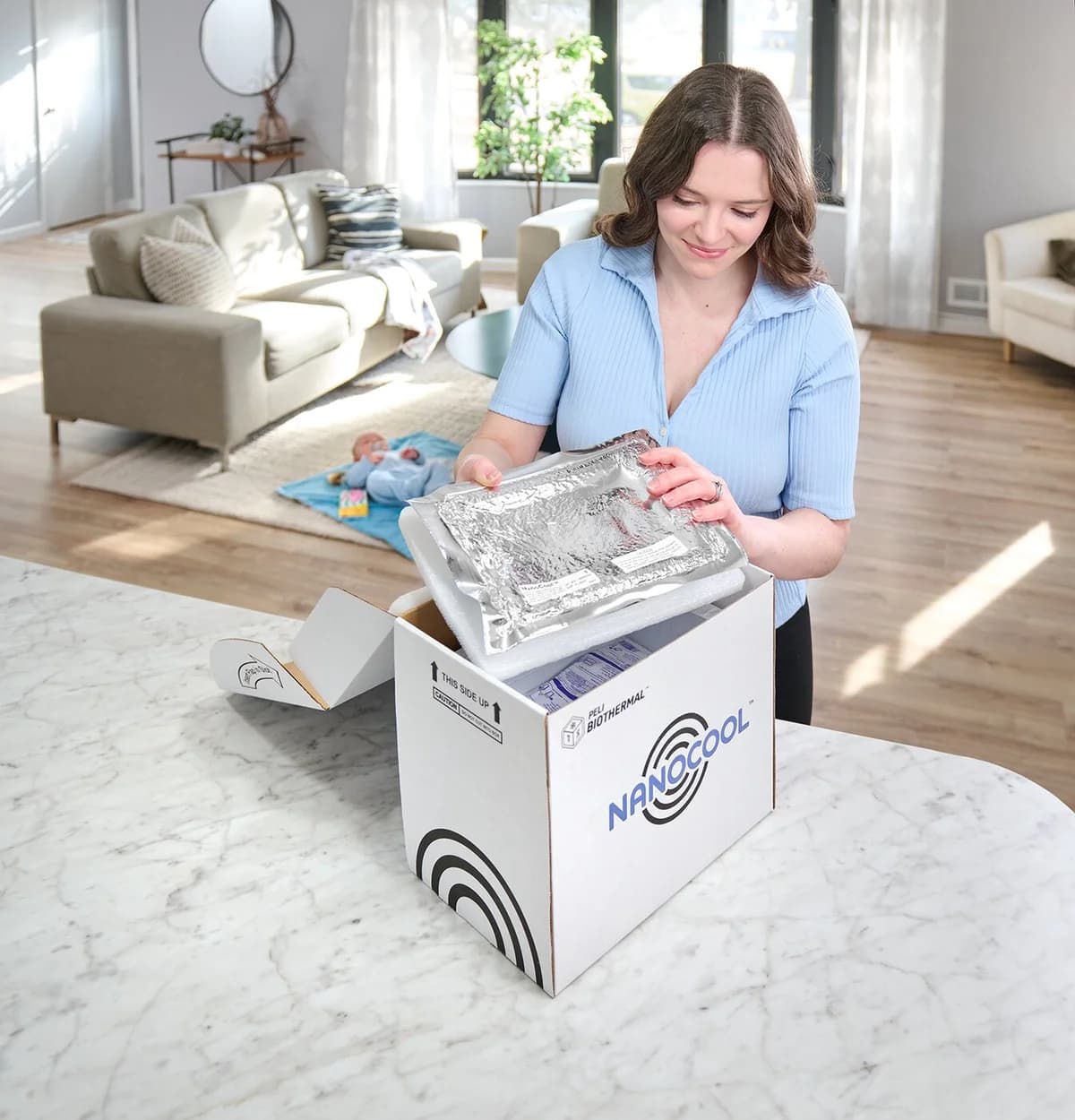
NanoCool fits 2–8°C specimens packed somewhere with no cold-chain setup: a physician's office, a collection depot, a mobile draw, a decentralized clinical trial site, or a patient's home.
Nothing stops you from running all three, matched lane by lane to each specimen type.
| Feature | Dry ice | Gel packs | NanoCool™ |
|---|---|---|---|
| Holds refrigerated 2–8°C | ✗ | ✓ | ✓ |
| Holds deep-frozen (−70°C and below) | ✓ | ✗ | ✗ |
| No freezer or refrigerator needed at the packing site | ✗ | ✗ | ✓ |
| Ready to use straight from room-temperature storage | ✗ | ✗ | ✓ |
| No conditioning or pre-cooling step | ✗ | ✗ | ✓ |
| Low risk of freezing a refrigerated specimen | ✗ | ✗ | ✓ |
| Non-hazardous for air transport | ✗ | ✓ | ✓ |
| Minimal training needed to pack correctly | ✗ | ✗ | ✓ |
| Low dimensional weight | ✗ | ✗ | ✓ |
| Reusable | ✗ | ✓ | ✗ |
| Lowest per-unit cost | ✗ | ✓ | ✗ |
| Flexible sizing for any payload | ✓ | ✓ | ✗ |
How DS2 handles cold-chain packaging
Diagnostic Support Services (DS2) has used NanoCool cooling systems in its temperature-controlled specimen collection kits since 2019, and now offers the full NanoCool range across every kitting program it builds. DS2 builds the kit, supplies the packaging, runs the courier network, and integrates results with customer LIS and LIMS systems, so the packaging choice is made alongside the rest of the workflow instead of in isolation.
Explore DS2 medical courier services · Request a sample kit
Frequently asked questions
Can I use dry ice for refrigerated (2–8°C) specimens?
No. Dry ice sublimates at about −78.5°C (−109.3°F) and will freeze refrigerated specimens. Use gel packs or an evaporative cooling system such as NanoCool for 2–8°C shipments.
Do gel packs need to be frozen before shipping?
Yes. Most gel packs need conditioning in a freezer or refrigerator before use; Labcorp's client instructions specify four hours or more, frozen solid. Keep packs taken straight from the freezer out of direct contact with refrigerated specimens.
Does NanoCool need a freezer or refrigerator?
No. NanoCool shippers from Peli BioThermal are stored at room temperature (17–25°C) and activated with a single button. They must not be frozen or packed with dry ice.
How long does NanoCool keep specimens at 2–8°C?
NanoCool systems are qualified for 40 to 96 hours depending on the model: NanoCool Shuttle up to 40 hours, NanoCool Cooling Systems 48 to 92 hours, and NanoCool Universal Systems 48 to 96 hours.
Is dry ice a hazardous material?
When shipped by air, yes. Dry ice is classified as UN1845, Class 9. Under 49 CFR 173.217, packages must let carbon dioxide vent and carry the dry ice label and net weight.
Which option is most sustainable?
It depends on the lane. In a closed loop where packs come back, reusable gel packs produce the least waste. In one-way shipping, a lighter single-use system such as NanoCool can cut freight emissions compared with a heavy EPS-and-refrigerant pack-out.
How long has DS2 used NanoCool?
Diagnostic Support Services (DS2) has used NanoCool cooling systems in its temperature-controlled specimen collection kits since 2019, and offers the full NanoCool range across all of its kitting programs.
Sources
- eCFR, 49 CFR 173.217: Carbon dioxide, solid (dry ice)
- Dry Ice Corp, What Is the Sublimation Rate of Dry Ice?
- Labcorp, Frozen Gel Pack Instructions for Use (PDF)
- Resource Recycling Systems via Waste Advantage Magazine, EPS packaging recycling rate in North America (2022)
- Peli BioThermal, NanoCool Cooling Systems, NanoCool Universal Systems and the NanoCool Family of Shippers sell sheet (PDF)
NanoCool™ is a trademark of Peli BioThermal.