



Temperature-Controlled Specimen Transport
Every analyte has a band it must stay inside between the draw and the bench. DS2 matches the packout to the band, the lane, and the person doing the packing, from conditioned gel packs to push-button NanoCool shippers.
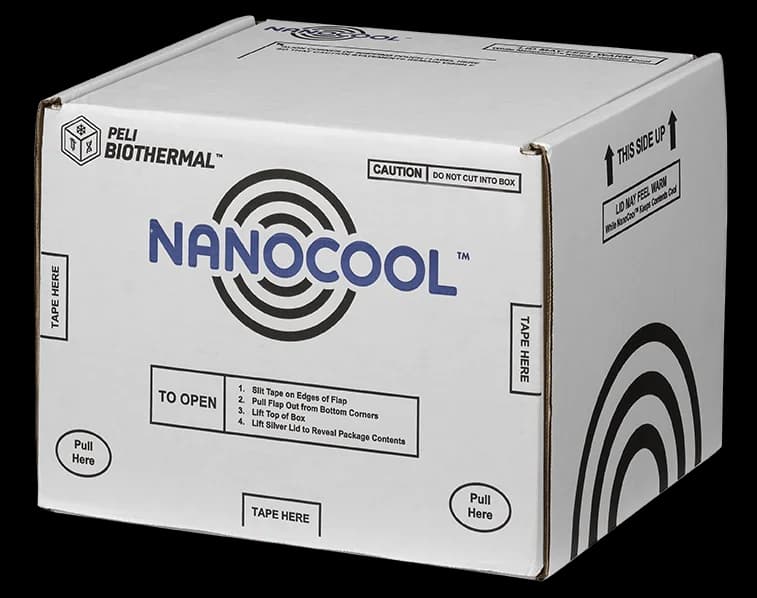
NanoCool Cooling System. Image: Peli BioThermal.
Four Bands, Four Different Problems
The right question is never how cold the box is. It is whether the specimen stayed inside the band its test is validated for, with the record to prove it.
Controlled Room Temperature
20 to 25°CAmbient-stable analytes in insulated packaging that shields against summer trucks and winter docks. Excursions of 15 to 30°C are permitted under USP <659>.
Refrigerated
2 to 8°CThe most common band for clinical specimens. Conditioned gel packs from equipped sites, or NanoCool evaporative shippers where the packing site has no freezer.
Frozen
−25 to −10°CSpecimens validated for frozen transit, moved with conditioned phase-change packouts and a logger where the analyte requires evidence.
Dry Ice
approx. −78.5°CFrozen biologics and long-haul frozen shipments as UN1845 Class 9 dangerous goods, packed by DOT and IATA trained staff in vented packaging.
The standards behind the bands are covered in the cold chain shipping guide; the packaging rules for the return leg live in the UN3373 Category B guide.
Refrigerated Specimen Shipping: Gel Packs, Dry Ice, or NanoCool
Three refrigerant methods, none interchangeable. Matching the wrong one to a lane is one of the more avoidable ways to lose a sample.
Refrigerated specimen shipping keeps diagnostic specimens at 2–8°C from pickup to the laboratory, using conditioned gel packs or push-button evaporative shippers such as NanoCool™, which hold 2–8°C for 40 to 96 qualified hours with no freezer at the packing site.
Dry ice is not a refrigerated method: at −78.5°C it freezes anything it travels with, which makes it the answer for frozen lanes and the wrong answer for this band. The full reasoning is in our dry ice vs gel packs vs NanoCool comparison.
| Feature | Dry ice | Gel packs | NanoCool™ |
|---|---|---|---|
| Holds refrigerated 2–8°C | ✗ | ✓ | ✓ |
| Holds deep-frozen (−70°C and below) | ✓ | ✗ | ✗ |
| No freezer or refrigerator needed at the packing site | ✗ | ✗ | ✓ |
| Ready to use straight from room-temperature storage | ✗ | ✗ | ✓ |
| No conditioning or pre-cooling step | ✗ | ✗ | ✓ |
| Low risk of freezing a refrigerated specimen | ✗ | ✗ | ✓ |
| Non-hazardous for air transport | ✗ | ✓ | ✓ |
| Minimal training needed to pack correctly | ✗ | ✗ | ✓ |
| Low dimensional weight | ✗ | ✗ | ✓ |
| Reusable | ✗ | ✓ | ✗ |
| Lowest per-unit cost | ✗ | ✓ | ✗ |
| Flexible sizing for any payload | ✓ | ✓ | ✗ |
NanoCool™ Evaporative Cooling Shippers
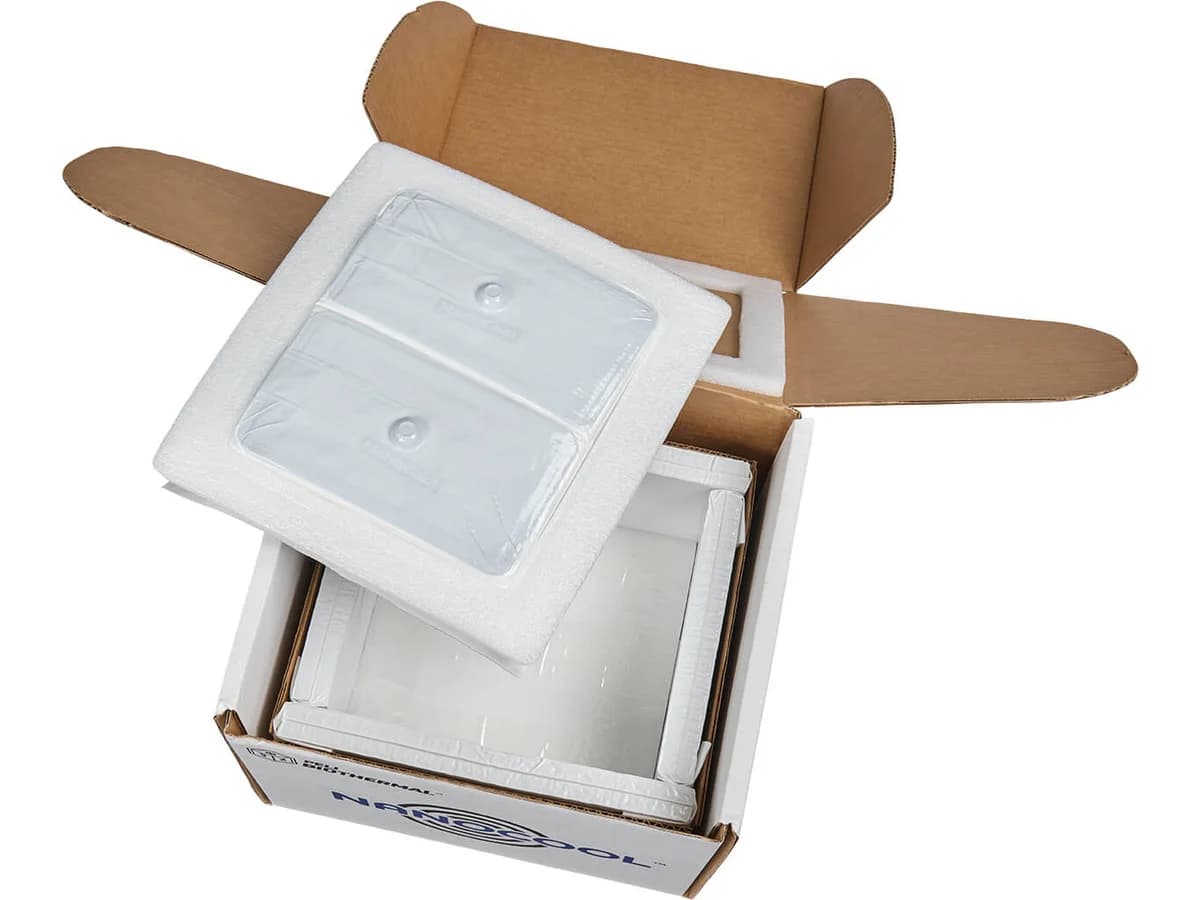
Each NanoCool shipper contains a vacuum-sealed cooling engine. Pressing the activation button starts water evaporating inside it, pulling heat out of the payload compartment; about 20 seconds later the logo turns blue to confirm it is working. Nothing is frozen or assembled beforehand, and units sit on a room-temperature shelf until someone needs one.
That removes the two failure points that dominate refrigerated lanes: the conditioning step and the freezer. A physician's office, a collection depot, or a patient at home can pack a compliant 2–8°C shipment with one button.
NanoCool holds 2–8°C only, not frozen. Frozen lanes stay on conditioned packs or dry ice.
NanoCool Cooling Systems
Evaporative cooling alone, qualified to hold 2–8°C for 48 to 92 hours.
NanoCool Universal Systems
Adds a phase change material layer for lanes with temperature spikes, qualified for 48 to 96 hours.
NanoCool Shuttle
The compact option, sized for UN3373-designated envelopes on overnight specimen runs of up to 40 hours.
A Packaging Option Inside a DS2 Program, Not a Product on a Shelf
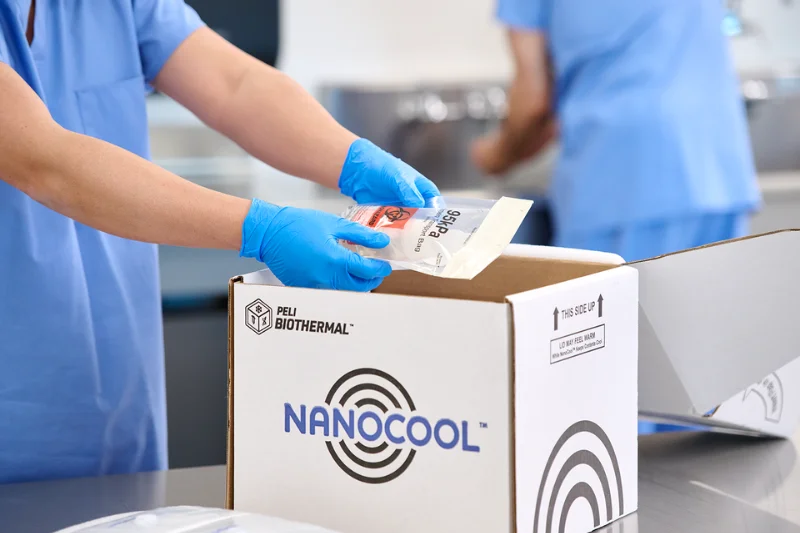
DS2 has packed NanoCool systems into its temperature-controlled specimen collection kits since 2019. You choose it the way you choose any packout: as the 2–8°C option in a kitting program or a courier program, specified against your analytes, lanes, and packing sites. The kit arrives with the shipper, the UN3373 packaging, and instructions written for whoever is doing the packing.
Temperature-Controlled Shipping Questions
Can I use dry ice for refrigerated (2–8°C) specimens?
No. Dry ice sublimates at about −78.5°C (−109.3°F) and will freeze refrigerated specimens. Use gel packs or an evaporative cooling system such as NanoCool for 2–8°C shipments.
Do gel packs need to be frozen before shipping?
Yes. Most gel packs need conditioning in a freezer or refrigerator before use; Labcorp's client instructions specify four hours or more, frozen solid. Keep packs taken straight from the freezer out of direct contact with refrigerated specimens.
Does NanoCool need a freezer or refrigerator?
No. NanoCool shippers from Peli BioThermal are stored at room temperature (17–25°C) and activated with a single button. They must not be frozen or packed with dry ice.
How long does NanoCool keep specimens at 2–8°C?
NanoCool systems are qualified for 40 to 96 hours depending on the model: NanoCool Shuttle up to 40 hours, NanoCool Cooling Systems 48 to 92 hours, and NanoCool Universal Systems 48 to 96 hours.
Get a Quote for Temperature-Controlled Transport
Tell us the analytes, the lanes, and who packs the box. We'll come back with the packout and the price.
NanoCool™ is a trademark of Peli BioThermal.