



UN3373 and Category B Specimen Shipping
A practical packaging guide: what UN3373 means, how Category B specimens must be packed under Packing Instruction 650, how to mark the box, what changes when you add dry ice, and who is legally responsible.
Published · Last updated
What is UN3373?
Most diagnostic specimens that move between a collection site and a laboratory are regulated cargo, not general freight, and the rules that govern them come down to numbers a shipper either hits or misses.
A UN number is the four-digit code that tells everyone in the transport chain what is inside a package. When the diamond-shaped UN3373 mark is on the box, it says this holds a biological substance in Category B, packed to a defined international standard.
In short
UN3373 is the UN number for “Biological substance, Category B”: infectious substances that do not meet the criteria for the most dangerous class. It is the classification under which the large majority of routine diagnostic specimens travel, including blood, urine, tissue, and swabs sent for testing.
Category A, Category B, and exempt specimens
Before packaging anything, the shipper has to classify it. There are three practical buckets, and everything downstream depends on getting this right.
Category A
In the words of 49 CFR 173.134, an infectious substance "in a form capable of causing permanent disability or life-threatening or fatal disease in otherwise healthy humans or animals when exposure to it occurs." It must be assigned to UN2814 (affecting humans), UN2900 (affecting animals), or UN3549 (Category A medical waste), and ships under the much stricter Packing Instruction 620.
Category B
An infectious substance "not in a form generally capable" of causing that level of harm, including substances transported for diagnostic or investigational purposes. It is described as "Biological substance, Category B", assigned UN3373, and ships under Packing Instruction 650. Note it excludes regulated medical waste, which is UN3291.
Exempt human or animal specimen
Per WHO guidance, patient specimens with a minimal likelihood that pathogenic agents are present, such as samples for cholesterol, glucose, hormone, pregnancy, or drug testing where infection is not suspected. Not regulated as infectious substances, but still triple-packaged and leak-proof, with the outer packaging marked "Exempt human specimen".
The classification decision belongs to the shipper, and it is a professional judgment made on what is known about the patient and the specimen, not a default. When in doubt, the safe direction is to package to the higher standard.
Get the Specimen Transport Guide
Packaging, temperature bands and chain of custody in one PDF. Download the free Specimen Transport Guide.
How to package a Category B shipment
Packing Instruction 650 sets out a triple-packaging system with specific, testable requirements.
| Requirement | Specification |
|---|---|
| Packaging system | Triple packaging: a primary receptacle, a secondary packaging, and a rigid outer packaging |
| Primary receptacle | Leak-proof, and must not contain more than 1 litre |
| Secondary packaging | Leak-proof (sift-proof for solids), packed so primary receptacles cannot break, puncture, or leak into it |
| Absorbent material | Placed between primary and secondary, in a quantity sufficient to absorb the entire contents of all primary receptacles |
| Pressure rating (liquids) | Primary receptacle or secondary packaging withstands an internal pressure of 95 kPa, from -40°C to +55°C, without leakage |
| Outer packaging | Rigid, and must not contain more than 4 litres (excluding ice, dry ice, or liquid nitrogen) |
| Minimum dimension | At least one surface of the outer packaging measures a minimum of 100 mm x 100 mm |
| Drop test | The completed package passes a drop test from a height of not less than 1.2 m, with no leakage from the primary receptacle |
| Documentation | An itemized list of contents enclosed between the secondary packaging and the outer packaging |
For solids, the primary and secondary packagings must be sift-proof. If there is any doubt whether residual liquid may be present during transport, a packaging suitable for liquids, including absorbent material, must be used.
Marking the package
A correctly packed box is still non-compliant if it is not correctly marked. Category B shipments require the UN3373 mark on the external surface of the outer packaging, on a background of contrasting colour, clearly visible and legible. It must be a square set at an angle of 45 degrees (diamond-shaped) with each side at least 50 mm long, a border line at least 2 mm wide, and letters and numbers at least 6 mm high. The entire mark must appear on one side of the package, and the proper shipping name “Biological Substance, Category B” must be marked adjacent to it in letters at least 6 mm high.
One detail is routinely got wrong: the requirement is 50 mm per side, not a 50 mm overall width. A square with 50 mm sides rotated to a diamond measures roughly 71 mm point to point, so a mark sized to 50 mm across is undersized and non-compliant.
Shipping with dry ice
Many specimens need to stay cold, and the refrigerant is itself regulated. Dry ice is a Class 9 dangerous good in its own right, shipped as UN1845 under the proper shipping name “Dry ice” or “Carbon dioxide, solid”. The critical design requirement is venting: under 49 CFR 173.217(a), dry ice offered for transportation by aircraft or water must be packed in packagings designed and constructed to permit the release of carbon dioxide gas, to prevent a build-up of pressure that could rupture the packaging. A sealed, airtight outer container with dry ice inside is a hazard, not a better package.
Under PI 650, ice or dry ice is placed outside the secondary packaging, or in the outer packaging or an overpack. Interior supports must secure the secondary packagings once the ice has dissipated, and if wet ice is used the outer packaging must be leak-proof. Both the primary receptacle and secondary packaging must maintain integrity at the refrigerant temperature, and at the temperatures and pressures that would result if refrigeration were lost.
Who is responsible?
This is the question that decides who carries the risk. Under 49 CFR 173.22, a person may offer a hazardous material for transportation only if they class and describe it in accordance with the regulations and determine that the packaging is an authorized packaging, properly manufactured, assembled, and marked to specification. Package marking and labeling are imposed separately, by 49 CFR 172.300(a) and 172.400(a). In practice the offeror is the laboratory or clinic sending the specimen, not the driver who collects it.
Separately, everyone whose work directly affects hazardous materials transportation safety is a hazmat employee under US DOT rules and must be trained and tested, with recurrent training at least once every three years. A specialist kitting and courier partner reduces the risk, but it does not transfer the legal responsibility.
A practical compliance checklist
Classify first. Category A, Category B, or exempt? Everything downstream depends on this.
Triple package: leak-proof primary, leak-proof secondary, rigid outer.
Use absorbent that actually absorbs, enough for the entire liquid contents, not a token sheet.
Check the 95 kPa rating on the primary or secondary when shipping liquids.
Respect the volume limits: 1 litre primary, 4 litres outer, excluding refrigerant.
Check the outer dimension: at least one surface 100 mm x 100 mm.
Mark it properly: the UN3373 diamond plus the proper shipping name adjacent to it.
Enclose the itemized list of contents between the secondary and outer packaging.
Vent for dry ice, keep refrigerant outside the secondary packaging, and support the contents.
Confirm the people packing and carrying are trained, and that the training is current.
Compliance is designed in, not inspected in
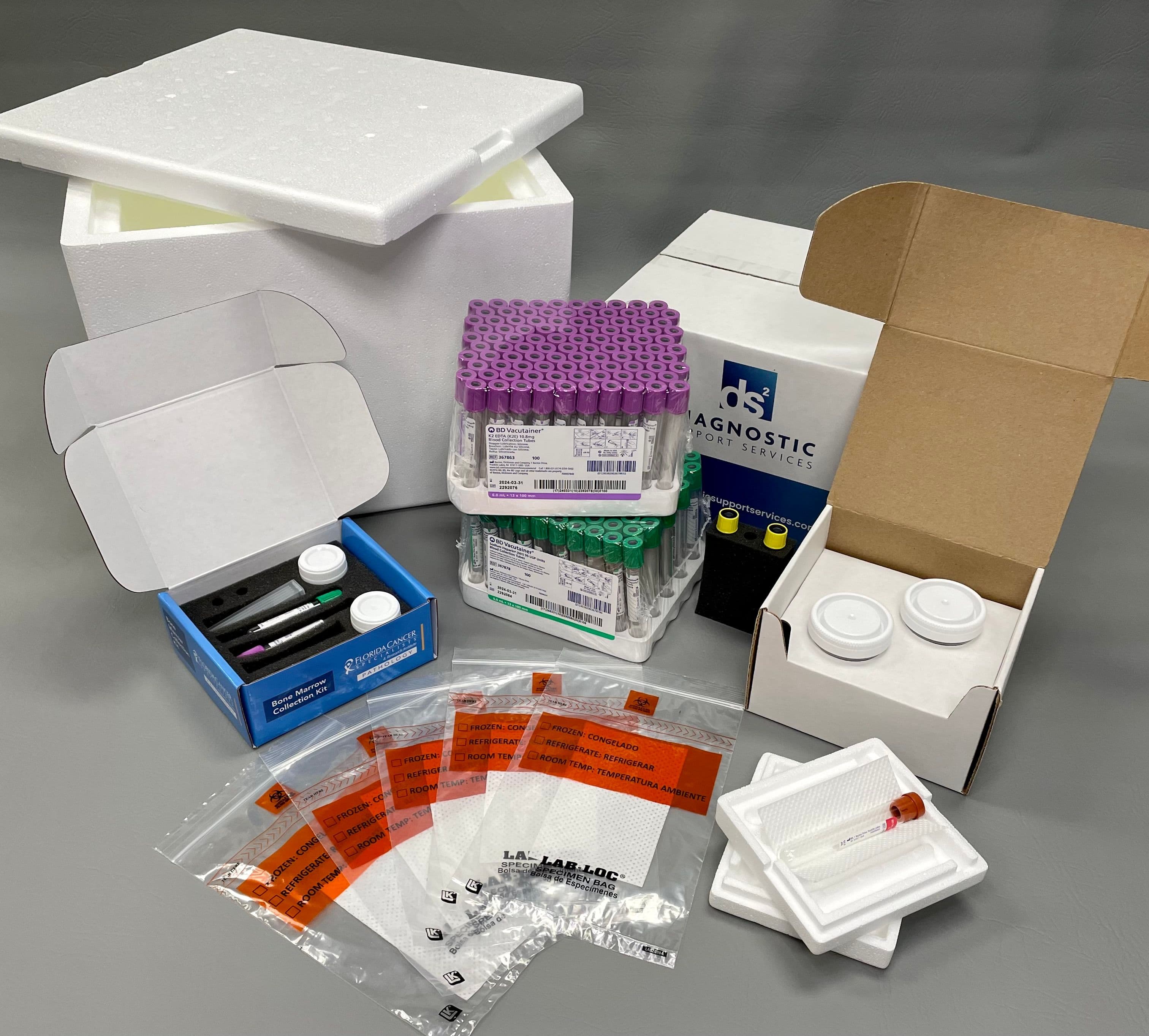
DS2 sits on both sides of this problem. The custom kits DS2 builds are designed to ship compliantly, with the correct primary receptacles, 95 kPa bags, absorbent, and rigid outer packaging specified into the bill of materials rather than added at the dock. The same discipline runs through clinical trial kitting, where the packout is fixed to the protocol before first patient in. The medical courier network that moves them is DOT and IATA dangerous-goods certified, with hazmat-trained staff, and the specimen logistics behind it records each handoff from pickup to the receiving lab.
If the kit that arrives at a collection site already contains the right components in the right configuration, the person packing the specimen is far less likely to improvise something non-compliant.
UN3373 and Category B questions
What does UN3373 mean?
UN3373 is the UN number for Biological substance, Category B, the classification covering most routine diagnostic and clinical specimens shipped for testing. It signals that the package contains an infectious substance that does not meet the stricter Category A criteria, packed to the international standard set by Packing Instruction 650.
What is the difference between Category A and Category B?
Category A is an infectious substance in a form capable of causing permanent disability or life-threatening or fatal disease in otherwise healthy humans or animals; it is assigned UN2814 (affecting humans), UN2900 (affecting animals), or UN3549 (Category A medical waste) and ships under much stricter rules. Category B is an infectious substance not in a form generally capable of causing that level of harm, including specimens moved for diagnostic purposes; it ships as UN3373. Regulated medical waste is excluded from Category B and is assigned UN3291. Specimens with minimal likelihood of containing pathogens may qualify as exempt specimens instead.
How big does the UN3373 mark have to be?
The mark is a square set at 45 degrees (diamond-shaped) with each side at least 50 mm long, a border line at least 2 mm wide, and letters and numbers at least 6 mm high, displayed on a contrasting background with the entire mark on one side of the package. The proper shipping name 'Biological Substance, Category B' must appear adjacent to it in letters at least 6 mm high. Note that the 50 mm applies to each side, not the overall width: a compliant diamond measures roughly 71 mm point to point.
What is a 95 kPa bag?
It is a specimen transport bag rated to withstand an internal pressure of 95 kPa without leaking, across a temperature range of -40°C to +55°C. Packing Instruction 650 requires that either the primary receptacle or the secondary packaging meets this rating when shipping liquids, and the bag is the usual way to satisfy it.
Does a UN3373 package have to pass a drop test?
Yes. The completed package must be capable of passing a drop test from a height of not less than 1.2 m, with no leakage from the primary receptacle, which must remain protected by absorbent material within the secondary packaging.
Can I ship specimens with dry ice?
Yes, but dry ice is itself a Class 9 dangerous good, shipped as UN1845. Under 49 CFR 173.217(a), dry ice offered for transport by aircraft or water must be packed in packaging designed to permit the release of carbon dioxide gas so pressure cannot build up and rupture the package. Under Packing Instruction 650, the dry ice goes outside the secondary packaging, and interior supports must hold the secondary packaging in place after the dry ice sublimates.
Who is responsible for correct packaging, the lab or the courier?
The offeror, meaning the organization that offers the specimen for transport, is responsible for determining that the packaging is authorized and properly prepared. That is normally the laboratory or clinic sending the sample. A specialist kitting and courier partner reduces the risk, but does not transfer the legal responsibility.
Get the Specimen Transport Guide
Packaging, temperature bands and chain of custody in one PDF. Download the free Specimen Transport Guide.
References
- 1.IATA Dangerous Goods Regulations, Packing Instruction 650 (UN3373, Biological Substance, Category B). Source of the triple-packaging, 1 L / 4 L, absorbent, 95 kPa, 100 mm, 1.2 m drop-test and mark-dimension requirements.
- 2.49 CFR 173.134: definitions of Category A and Category B infectious substances, and assignment to UN2814, UN2900, UN3549 and UN3373.
- 3.49 CFR 173.199: US requirements for Category B (UN3373) packagings, including the mark specification.
- 4.WHO, Guidance on regulations for the Transport of Infectious Substances 2021-2022: classification, and the exempt human/animal specimen criteria, packaging, and marking.
- 5.49 CFR 173.217: dry ice (UN1845), including the requirement that packagings permit the release of carbon dioxide gas for transport by aircraft or water.
- 6.49 CFR 173.22: offeror responsibility for classing and describing hazardous materials and determining the packaging is authorized (marking and labeling duties sit at 49 CFR 172.300(a) and 172.400(a)).
- 7.49 CFR 172.704: hazmat employee training and testing, recurrent at least once every three years.
Scope and currency: 49 CFR is US Department of Transportation law and governs transport in US commerce. International air shipments are governed by the ICAO Technical Instructions as implemented in the IATA Dangerous Goods Regulations, and road transport in Europe by ADR. The IATA DGR updates annually and the WHO guidance biennially. This guide reflects the sources listed above and is provided for general information; the shipper is responsible for compliance with the edition in force at the time of shipment.
Ready to Simplify Your Diagnostic Workflow? Let's Talk.
No commitment required. Our team responds within 24 hours.